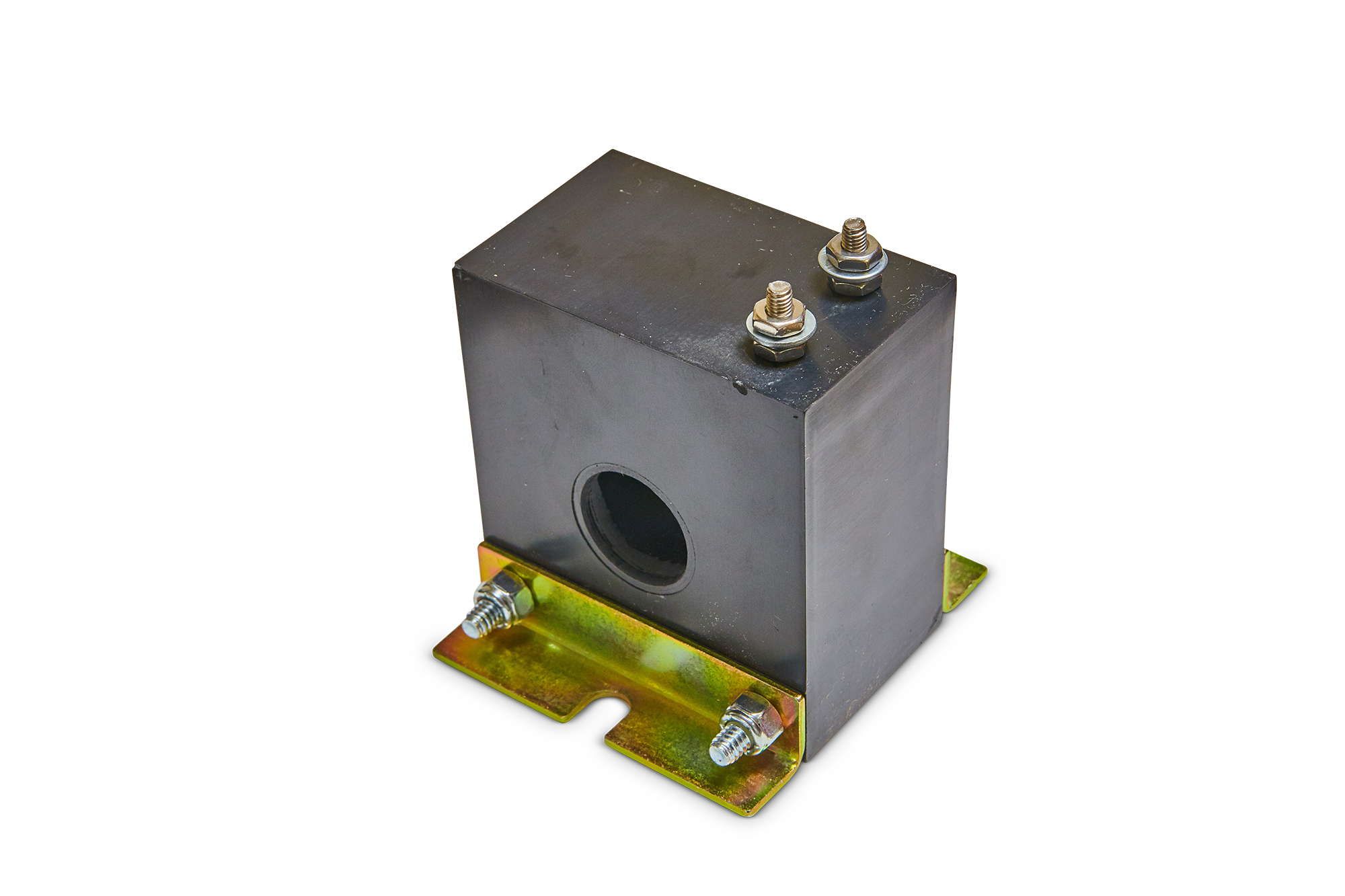
Electrical engineers and OEM design teams often reach a point where they must decide whether a toroidal transformer is the right fit for their system. Toroidal designs offer compelling advantages in size, efficiency and noise performance; but they also introduce unique engineering considerations.
A key characteristic of tape-wound toroid cores is that they are typically custom manufactured, with few standard off-the-shelf models available. While this increases cost and design complexity, it also enables the core to be tailored for optimal performance in a specific application.
This guide breaks down how toroidal transformers work, where they excel, and when a different transformer configuration may be the better choice.
What Is a Toroidal Transformer?
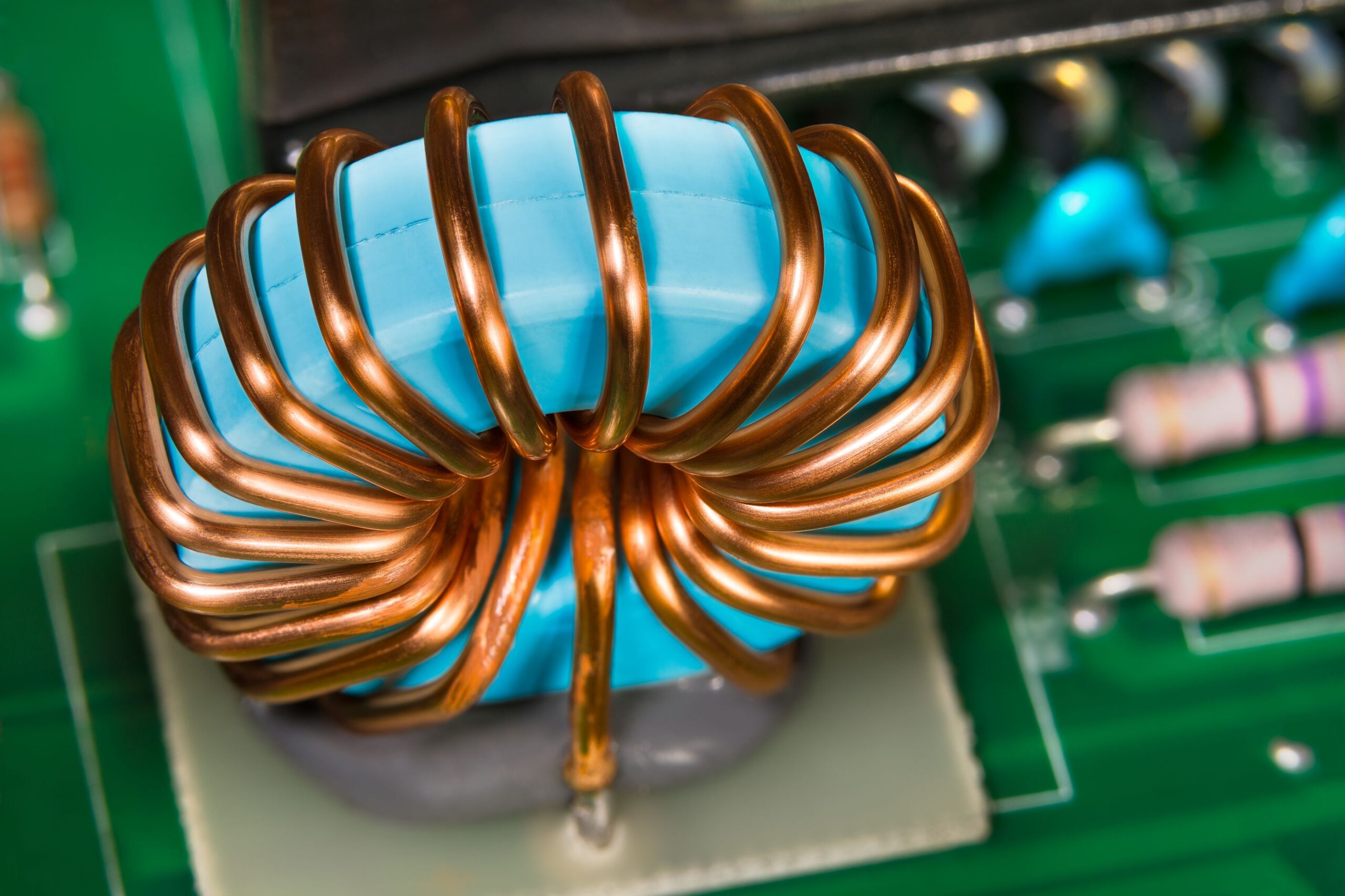
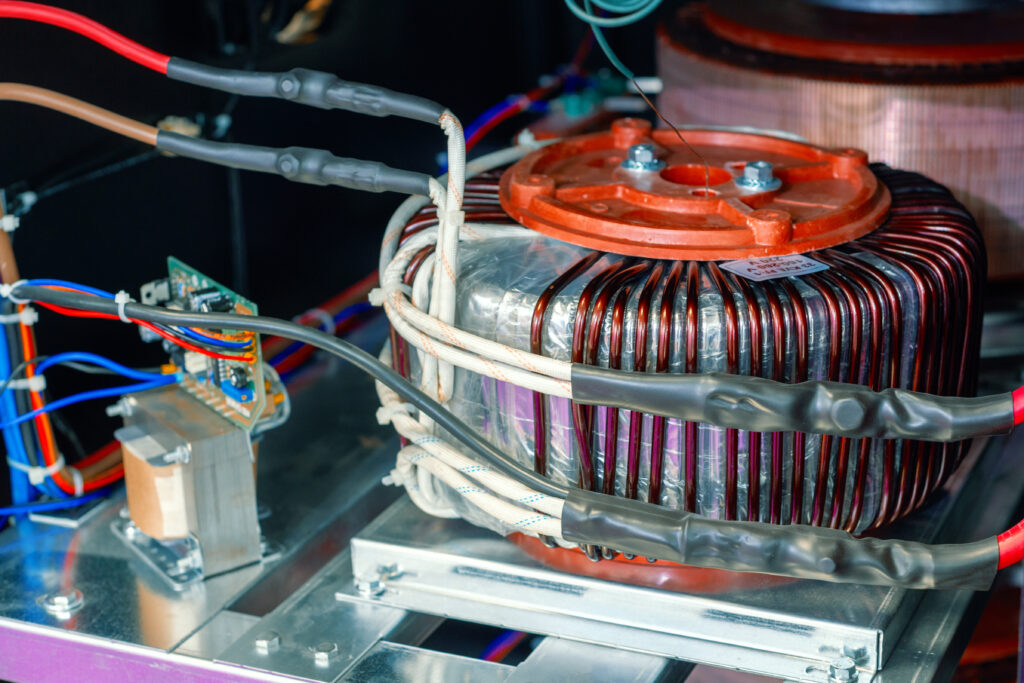
A toroidal transformer uses a ring‑shaped magnetic core, typically made from grain‑oriented silicon steel or other high‑performance core materials. Instead of the stacked laminations found in EI‑core transformers, the toroidal core is a continuous strip wound into a closed loop. Both the primary and secondary windings are distributed evenly around the core, threading through its center. This geometry creates a highly efficient magnetic path with minimal air gaps; the foundation of the toroid’s performance advantages.
How does a toroidal transformer differ from an EI‑core transformer? EI cores use stacked laminations with inherent air gaps, while toroids use a seamless core with a shorter magnetic path. Another difference: EI cores are easier to wind and modify than toroids which require specialized winding equipment and techniques.
Primary Benefits of Toroidal Transformers
Compact Size Relative to Power Capacity – closed magnetic path allows toroids to deliver more power in a smaller footprint, ideal for equipment with strict diameter or height constraints.
- High Efficiency – the low core losses and tight coupling between windings improve overall efficiency, especially at higher VA ratings.
- Lower Stray Magnetic Field – toroids naturally contain flux, reducing electromagnetic interference (EMI). This makes them a strong choice for audio, instrumentation and communication equipment.
- Reduced Audible Hum – with proper core preparation and winding tension, toroidal transformers operate quietly, a major advantage in noise‑sensitive environments.
- Low No‑Load Losses & Cooler Operation – the continuous core reduces magnetizing current, often resulting in lower temperature rise and improved long‑term reliability.
Potential Limitations and Tradeoffs for Toroidal Transformers
Toroidal transformers are not ideal for every project. Here are some factors that engineers should consider when deciding on a type of transformer.
- More Complex Winding Process – threading wire through a closed core requires specialized tooling and skilled operators.
- Higher Inrush Current – some toroidal designs exhibit higher magnetizing inrush, which may require circuit‑level mitigation.
- Mounting Considerations – toroids typically use center‑bolt or potted mounting. Applications requiring side‑mounting or bracketed assemblies may favor EI or R‑core designs.
- Cost Differences – material and labor requirements can make toroids more expensive at certain power levels.
- Limited Access for Modifications – reworking windings or adding taps is more challenging compared to laminated cores.
- Thermal and Insulation Requirements – proper insulation, spacing and thermal management are essential due to the compact geometry.
Common Applications
Toroidal transformers are commonly found in audio amplifiers and professional sound equipment, medical and laboratory devices, test and measurement systems, industrial controls, power supplies, communication equipment and other noise‑sensitive electronics. These applications rely on the toroid’s naturally low noise, compact form factor and high efficiency; the core strengths that make toroidal designs so effective across demanding environments.
Key Custom‑Design Variables
A custom toroidal transformer is shaped by a range of engineering parameters that directly influence its electrical performance and physical design. The input and output voltage requirements establish the fundamental turns ratio, while the VA rating defines the power-handling capability. Operating frequency affects core material choice and winding strategy, and regulation requirements determine how tightly the transformer must maintain voltage under load.
Efficiency goals and allowable temperature rise guide thermal design and material selection. Physical constraints such as available diameter and height dictate core size and winding geometry. Additional considerations include electrostatic or magnetic shielding, the chosen insulation system, lead‑wire and termination style, mounting method, and any environmental or safety compliance requirements. Together, these variables drive decisions around core selection, winding configuration, and thermal management, ultimately shaping the transformer’s performance and reliability.
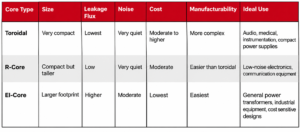
Toroidal vs. R‑Core vs. EI‑Core Transformers
No single transformer style is universally “best.” The right choice depends on application‑specific engineering priorities, not a universal ranking. The table below shows the distinct advantages of each configuration.
When to Choose a Custom Toroidal Transformer
A toroidal transformer is often the best fit when your project involves:
- Limited space or strict dimensional constraints
- Low‑noise or low‑EMI requirements
- Unique voltage combinations or multi‑secondary designs
- Specialized mounting needs
- Tight thermal restrictions
- Replacement of obsolete or discontinued components
If your system demands high efficiency, quiet operation and compact packaging, a custom toroidal transformer is worth strong consideration.
Why Engineers Choose Custom Magnetics Inc.
Custom Magnetics delivers end‑to‑end support for toroidal transformer design and manufacturing, backed by more than five decades of magnetics expertise. Our team manufactures toroidal, laminated EI, ferrite‑core and R‑core transformers, and provides engineering guidance to help you select the right core and winding configuration. We support projects from prototype through full production, perform application‑specific electrical and thermal testing, and develop custom magnetic solutions for OEMs across audio, medical, industrial and power‑electronics markets.
Ready to Determine Whether a Toroidal Transformer Is Right for Your Application?
Share your voltage, power, size and operating requirements with Custom Magnetics to determine whether a toroidal transformer is the best fit.